

Every winter there’s a week when Utah Valley disappears under a gray lid and Y Mountain vanishes from the view out your front window. Most advice for those days is about the air outside. The quicker win is inside your house.
Inversion season cleaning in Provo comes down to one rule: remove fine dust, don’t move it. That means damp cloths instead of feather dusters, a sealed HEPA vacuum, cleaning from the ceiling down, and saving the jobs that kick up the most dust for days when the air quality forecast is green or yellow.
The rest of this guide explains why that rule matters in Utah County, how to apply it room by room, and how to plan a week of cleaning around the state’s air forecast. You won’t need new gadgets. Most of it uses tools already under your sink.
What Inversion Season Means for the Air Inside a Provo Home
An inversion happens when cold air settles on the valley floor under a layer of warmer air. The warm layer acts like a lid, so exhaust, wood smoke and other pollution build up near the ground instead of rising and dispersing. According to the Utah Department of Environmental Quality, a typical Utah winter brings five to six multi-day inversion episodes and, on average, 18 days when fine particle levels exceed the federal health standard.
Provo knows this pattern well. The EPA classified the Provo area as a “Serious” nonattainment area under the 2006 24-hour standard for fine particles, and the area now holds maintenance status, according to the EPA Green Book. The air has improved enough to meet the standard, but the valley’s shape hasn’t changed. Utah Valley sits between the Wasatch Mountains and Utah Lake, and the same cold-air pooling that makes January mornings so crisp keeps pollution parked over Provo and Orem during calm, high-pressure weeks.
The pollutant that matters most indoors is PM2.5: fine particles 2.5 micrometers across or smaller. The EPA puts that in perspective: an average human hair is about 70 micrometers wide, roughly 30 times larger than the largest fine particle. Particles that small slip in through door gaps, window frames and the furnace’s fresh-air intake. Once inside, they land on the same shelves, screens and floors you clean every week.
Outdoor air isn’t the only source. Cooking, candles, fireplaces and ordinary household dust add particles of their own, and in winter the house stays shut, so whatever is generated indoors has fewer ways out.
Why Dry Dusting Makes Inversion Days Worse
A feather duster feels productive. You watch the dust leave the shelf. A lot of it is just moving into the air, though, and the finest particles stay airborne long enough to settle somewhere else or get breathed in.
Damp dusting is wiping surfaces with a slightly moistened cloth so dust sticks to the fibers instead of lifting into the air. It’s the standard method in hospitals, and it’s the single biggest change most Provo households can make for winter.
The same logic applies to vacuums. A vacuum without a sealed HEPA filter catches the visible dirt and can blow some of the smallest particles back out the exhaust. Salt Lake City’s indoor air quality guidance recommends a HEPA filter on your vacuum, changed often, plus wet mopping and wiping surfaces, because dust, dirt and pet dander all contribute to particle pollution inside the home.
During a long inversion, check the tops of door frames, ceiling fan blades and TV screens. Still air and static let fine dust settle there first, and those are exactly the spots a dry duster flings back into the room.
How to Clean During Inversion Season, Step by Step
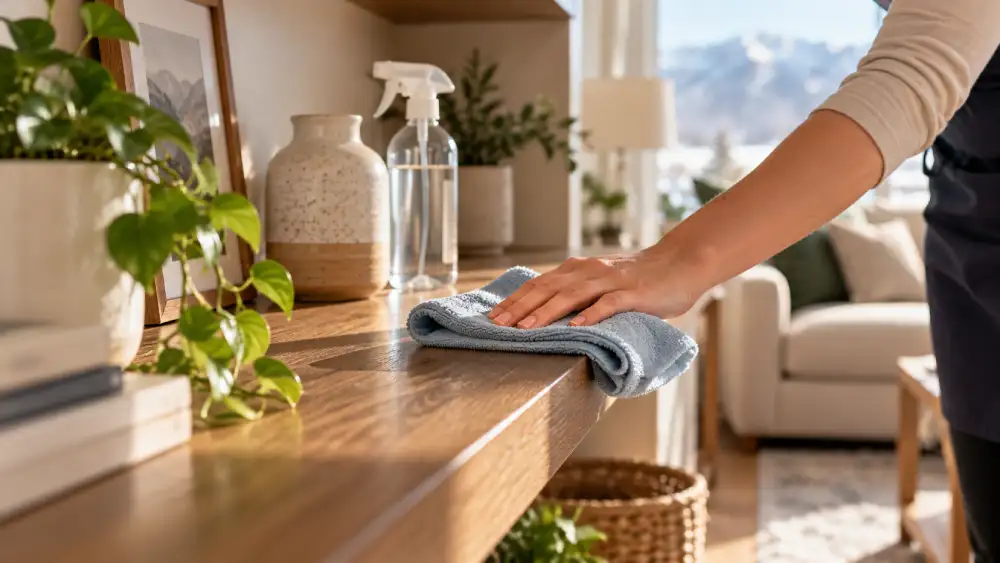
This is the method our crews use in winter, adapted for a homeowner with a Saturday morning and a basic cleaning caddy.
1. Work From the Ceiling Down
Dust falls. Start with ceiling fans, light fixtures, the tops of door frames and high shelves. Move to counters, tables and furniture next, and finish with baseboards and floors. Working in the other order means re-dusting surfaces you already wiped, and in inversion season that second layer arrives fast.
2. Use Damp Microfiber on Every Hard Surface
Lightly mist a microfiber cloth with water, or with a fragrance-free cleaner on greasy kitchen surfaces, and fold it into quarters so you have eight clean faces. Wipe in one direction instead of scrubbing in circles, and flip to a fresh face when the cloth turns gray. Barely damp is the target. If the cloth leaves streaks or water spots, it’s too wet.
For ceiling fan blades, slide an old pillowcase over each blade and pull it back toward you. The dust stays inside the fabric instead of raining onto the bed or sofa below. Shake the pillowcase out outdoors, then wash it.
3. Vacuum Slowly With a Sealed HEPA Vacuum
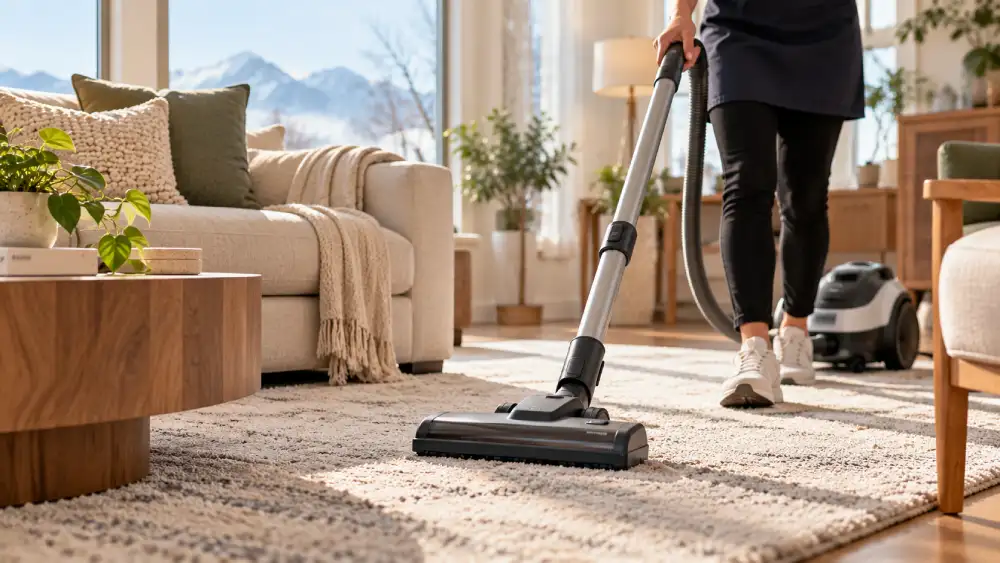
Vacuum after you dust, since dusting knocks some particles down to the floor. Go slower than feels natural on carpet and rugs and overlap your passes. Use the upholstery tool on sofas, chair cushions and the edges of the mattress, which collect more fine dust than most people expect. Empty the canister or change the bag outside, not over the kitchen trash, or you’ll release a cloud of exactly what you just collected.
4. Stop Dust at the Door
Fine particles ride in on shoes, coats and pets. A coarse mat outside and an absorbent mat inside, plus a shoes-off habit, cut down how much reaches the living room. During long inversion stretches, shake the mats out and wipe the entry floor more often than the rest of the house. It’s a two-minute job that saves a lot of vacuuming.
5. Change the Furnace Filter More Often
Your furnace runs hard through an inversion and pushes the air in your home through its filter over and over. Salt Lake City’s guidance says to change it at least every three months, more often during high pollution, and to use the highest-rated filter your system can handle. Higher-rated filters can capture as much as 85 percent of the smallest particles, compared with roughly 20 percent for low-rated ones.
Check your owner’s manual or ask an HVAC technician before jumping to MERV 13, since a filter that’s too restrictive can strain some systems. While you’re at it, wipe the supply vents and return grilles with a damp cloth so the furnace isn’t blowing out whatever settled on them.
6. Skip the Fragrance and the Flames
Candles, incense and wood fires add their own fine particles indoors. Air fresheners, plug-ins and heavily scented cleaners release volatile organic compounds, and EPA studies have found levels of common organic pollutants averaging 2 to 5 times higher inside homes than outside. For winter cleaning, fragrance-free products and a well-rinsed cloth do the job without adding to the load. Run the range hood every time you cook, especially when frying or sautéing.
Plan Your Cleaning Around the Air Quality Forecast
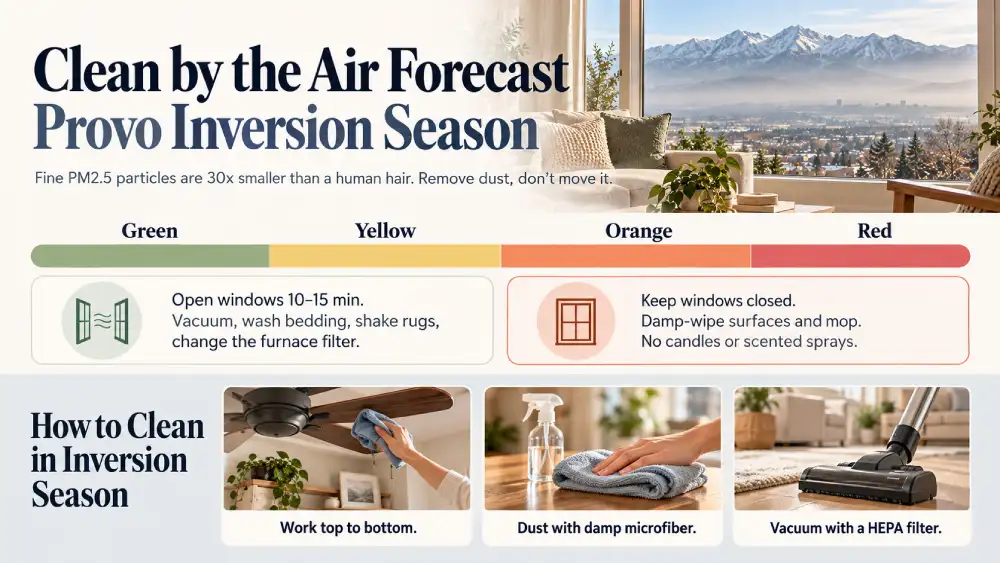
Most inversion advice stops at “keep the windows closed.” A better approach is to match the type of cleaning task to the day. The Utah Division of Air Quality publishes a color-coded forecast for Utah County at air.utah.gov and in the UtahAir app. Check it the night before you plan to clean.
| Air quality day | Windows | Best tasks for the day | Hold off on |
| Green or yellow | Open 10 to 15 minutes to air out | Vacuuming, shaking out rugs and mats, washing bedding and curtains, changing the furnace filter, wiping vents | Nothing in particular |
| Orange or red | Keep closed | Damp wiping, mopping hard floors, bathrooms, kitchen counters and appliances | Shaking rugs outdoors, dry dusting, scented sprays, candles, wood fires |
The first clear day after a storm breaks the inversion is your best window. Open the house up, wash the bedding, beat the entry rugs, vacuum everything and put in a fresh filter. The house then starts the next inversion clean instead of carrying the last one’s dust forward.
If someone in your home has asthma or another breathing condition, pick one bedroom as a clean room for the season, an approach Salt Lake City’s sustainability office also suggests. Damp-dust it twice a week, keep the door closed, and run a portable HEPA purifier there.
A Weekly Inversion-Season Routine for Provo Homes
Here’s how the method above fits into a normal week from November through the end of winter:
- Daily: wipe the entry floor, shake out the inside mat and run the range hood whenever you cook.
- Twice a week: damp-dust kitchen counters, tables, electronics and the surfaces people touch most.
- Weekly: a full top-to-bottom pass with damp microfiber, HEPA vacuuming of every floor and upholstered piece, mopping hard floors and washing pillowcases.
- On the first clear day after an inversion: air the house out, wash bedding and throws, shake the rugs and wipe the vents.
- Monthly during long inversion stretches: check the furnace filter and replace it if it looks gray, if your system allows a monthly change.
- Once a season: a deeper clean that reaches inside light fixtures, behind furniture, blinds and curtains. Our guide to deep cleaning vs. regular cleaning explains what that visit covers.
When a Professional Clean Makes Sense
Most of this is easy to keep up on your own. Where homeowners usually fall behind is the weekly top-to-bottom pass, because it’s the longest job and winter weeks are short.
Xquisite Homes now offers house cleaning in Provo, and our recurring house cleaning service can take the weekly top-to-bottom pass off your list. If you’d rather hand off the weekly pass and keep the daily habits, request a quote and tell us how many people and pets live in the home so we can plan the visit around what your house needs.
Fighting chalky spots on the shower glass this winter too? Our guide to hard water stains in Orem covers the same Utah Valley water and how to clean it off each surface.
Frequently Asked Questions
Why is my house so dusty in winter?
Because the house is closed up and the furnace keeps air moving. Doors and windows stay shut, so less fresh air comes in, while the heating system circulates indoor dust past every surface. In Provo, inversion stretches add fine outdoor particles that leak in through gaps around doors and windows.
Should I open windows during an inversion?
Not on orange or red air quality days. Keep windows closed when the air is bad, and air the house out for 10 to 15 minutes on green or yellow days, ideally right after a storm clears the valley. Run bathroom and kitchen exhaust fans either way.
Does vacuuming stir up dust?
It can if the vacuum doesn’t have a sealed HEPA filter. A standard vacuum picks up visible dirt but can blow fine particles back out the exhaust. A sealed HEPA model, slow overlapping passes and dusting before you vacuum keep most of it contained.
How do you dust without spreading it everywhere?
Use a slightly damp microfiber cloth and work from the highest surfaces down. The moisture makes particles cling to the cloth instead of lifting into the air. Fold the cloth into quarters and switch to a clean face as each one gets dirty.
Does dusting improve indoor air quality?
Yes, when it removes dust instead of moving it. Settled dust goes airborne again every time someone walks by or the furnace kicks on, so damp dusting and HEPA vacuuming reduce how much is available to stir up. It works best paired with a good furnace filter.
How long does an inversion last in Utah?
Usually several days, and sometimes more than a week. The Utah Department of Environmental Quality says a typical winter brings five to six multi-day inversion episodes, and it often takes a strong storm or low-pressure system to clear one out.
Make the Clear Days Count
Provo will get its gray weeks no matter what anyone does indoors. What you control is whether the dust from one inversion is still sitting on your shelves when the next one rolls in. A damp cloth, a HEPA vacuum, a high-to-low order and the big jobs saved for green days will get you most of the way there.
Want more seasonal cleaning advice for Utah homes? Browse the Xquisite Homes blog for for more guides.